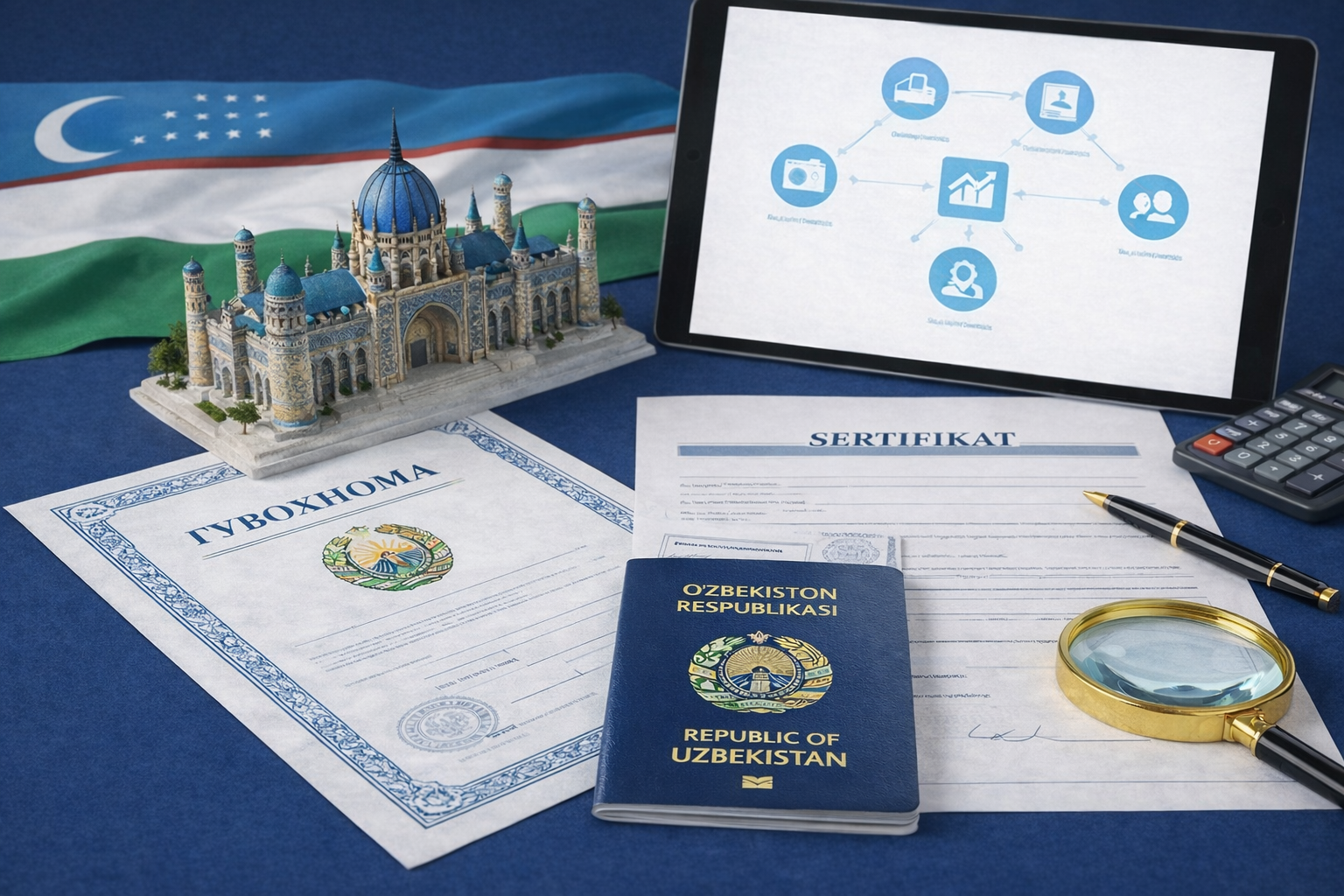
Company registration is the first and one of the most important steps when starting a business. A properly organized registration process ensures full compliance with legal requirements, reduces administrative risks, and allows entrepreneurs to focus on business development.
Uzbekistan is actively developing a favorable environment for entrepreneurship and attracting foreign investment. However, the company registration process requires compliance with established legal procedures, preparation of necessary documentation, and interaction with government authorities. Professional support helps ensure that the process is completed efficiently, correctly, and without unnecessary delays.
Loialte’s team of experienced legal and business consultants provides comprehensive support for company registration in Uzbekistan, including:
By partnering with Loialte, you receive professional support at every stage of the company registration process, ensuring that your business is established in full compliance with the legislation of the Republic of Uzbekistan and ready for successful operations.
Foreigners can register a company in Uzbekistan either remotely via the online business portal or in person at a Public Service Center (Davlat Xizmatlari Markazi). According to Presidential Decree No. PP-2646 and the Civil Code, the process begins with obtaining a Personal Identification Number (PINFL) and an electronic digital signature (ERI). Legally, foreign citizens must provide a notarized and apostilled passport translation, while foreign legal entities must provide extracts from their home country’s trade register. Practically, the most common structure for foreigners is the Limited Liability Company (LLC), which requires drafting a corporate Charter and a Founding Agreement. Once the documents are submitted, the state registration certificate is usually issued within 30 minutes. Risk-wise, failing to appoint a legitimate legal address or neglecting to register with the tax authorities immediately after formation can result in the suspension of the company’s bank accounts.
The official cost of company registration in Uzbekistan consists of a state duty, which is currently set at 1 Base Calculation Unit (BHM) for online applications and slightly higher for in-person filings. Under the Law “On State Duties,” foreign-invested enterprises (FIEs) may be subject to a different fee structure depending on their charter capital and the presence of foreign shareholders. Practically, the total “startup cost” also includes notary fees for document translation, the cost of a corporate seal (if desired), and the fees for obtaining a digital signature (ERI). It is important to note that while the state duty is low, the legal requirement to pay in the declared charter capital within one year must be planned for in the company’s budget. Additionally, choosing to register as a VAT payer at the outset is free but requires a separate application via the “taxes.uz” portal. Failure to pay the state duty correctly will result in the immediate rejection of the registration application.
For most standard business activities in Uzbekistan, there is no longer a mandatory minimum charter capital requirement for a Limited Liability Company (LLC). According to the Law “On Limited Liability and Additional Liability Companies,” founders are free to determine the size of the charter capital in the company’s Charter based on their operational needs. However, specific licensed sectors—such as banking, insurance, microfinance, and certain types of construction—must still meet strict capital thresholds defined by specialized legislation. Practically, for an Enterprise with Foreign Investment (EFI), a charter capital of at least 400 million UZS was historically used as a benchmark for certain benefits, though general registration is now more flexible. Legally, the declared capital must be fully contributed by the founders within the timeframe specified in the Charter, which cannot exceed one year from the date of state registration. Non-compliance with the contribution timeline can lead to the forced reduction of the capital or the liquidation of the entity.
After receiving a state registration certificate, a company in Uzbekistan must open a corporate settlement account at a commercial bank to conduct any financial transactions or pay taxes. Under the Law “On Banks and Banking Activity,” the director must present the company’s Charter, the registration certificate (Guvohnoma), and their own identification documents (including PINFL and ERI) to the bank. Practically, for companies with foreign founders, the bank will also perform an “Enhanced Due Diligence” (EDC) to verify the source of funds and the ultimate beneficial owners (UBO). Once the account is opened, the bank automatically notifies the tax authorities, enabling the company to start using electronic invoicing (e-faktura). Legally, the company must also register its “Signature Card” at the bank, which dictates who has the authority to move funds. Delaying this step prevents the company from fulfilling its legal requirement to settle social taxes for employees.
Yes, every legal entity in Uzbekistan is legally required to have a confirmed “legal address” (pochtaviy manzil) at the time of registration. According to the Civil Code, the legal address is where the permanent executive body of the company is located and where official correspondence from the tax and justice authorities is sent. Practically, this can be an owned premises, a leased office, or a space in a business incubator or coworking center that provides a valid lease agreement. In 2026, the State Tax Committee strictly monitors the authenticity of legal addresses, and using “mass registration addresses” can lead to the company being assigned a high-risk taxpayer status. If the company moves, it must update its registration data within 10 days to avoid administrative penalties. Maintaining a verified address is a core accounting and compliance requirement for the validity of the company’s VAT certificate.
Phone
Phone
Phone
Uzbekistan, Tashkent
United Arab Emirates, Dubai
Phone
Phone
Phone
Uzbekistan, Tashkent
United Arab Emirates, Dubai
Developed By Web Features 2026 All Rights Reserved